


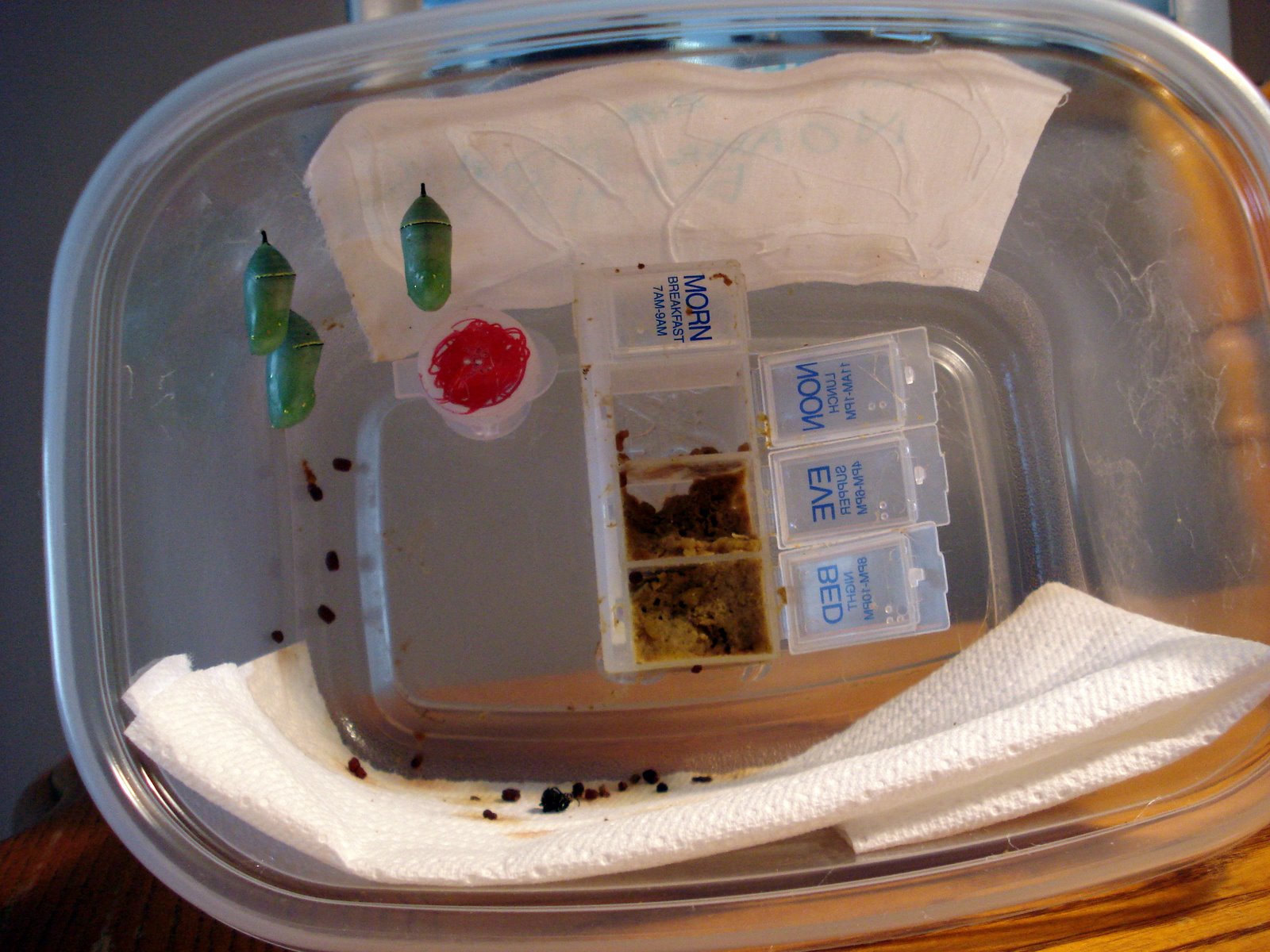
 We see our caterpillars are in various stages of beginning the process of pupating. From the Monarchs in Space Teachers Guide we understand that a caterpillar will empty its gut when it has finished developing and at that time produces frass with a pinkish hue. Pinkish frass is visible in the rearing boxes today. After emptying its gut, a monarch caterpillar will search for a sheltered, horizontal surface; as we see the caterpillars are orienting to the underside of the top of the rearing boxes.
To attach securely for the duration of the pupal (chrysalis) stage, the caterpillar spins a bed of silk and then a silk button in the center. It is from this button, with its anal prolegs (these are the pair of suction cup legs at the end of the caterpillar) anchored by crochets (tiny hooks on the legs) that the caterpillar releases it's hold and hangs like a letter J, upside down. It may, depending on the temperature, hang in this position for 12-16 hours.
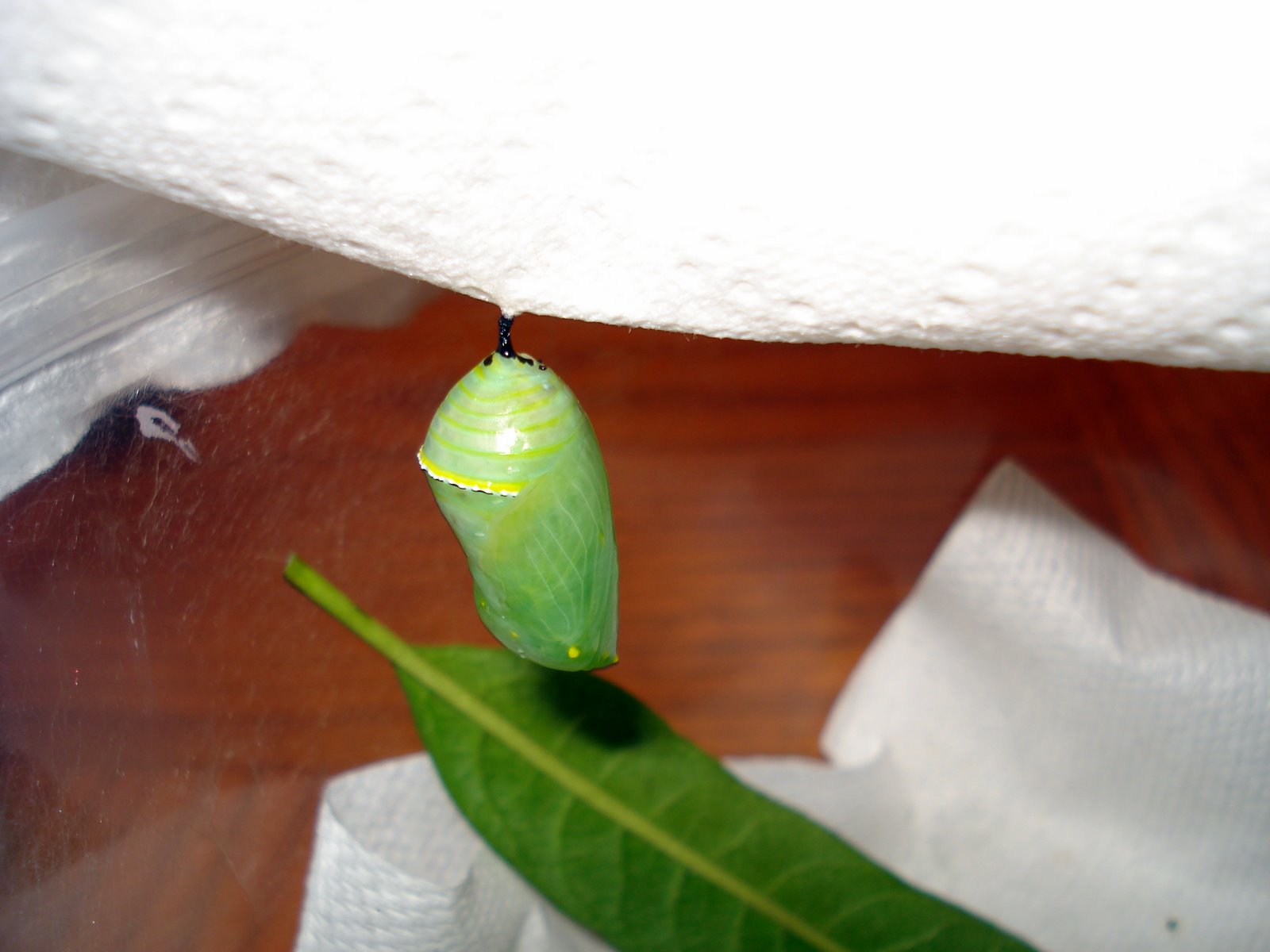
Toward the end of the J stage, the caterpillar's color changes due to the chrysalis developing inside and the caterpillar usually straightens in its hanging position. What happens next, happens quickly. Simply stated, the caterpillar succumbs to contractions that cause the caterpillar's skin to split and move upward toward the silk button attachment, revealing the chrysalis that has been forming. When the skin reaches the silk button, the caterpillar's cremaster is released and pushed into the silk button and the chrysalis twists to secure the cremaster to the silk.
Over the next few hours as this process repeats itself in our rearing boxes, we expect to see these beautiful, lime green jewels of metamorphosis hanging where our letter J stage caterpillars are hanging now.
Welcome home Atlantis and the crew of the STS-129 Mission. The landing was beautifully executed at 9:45 am at the Kennedy Space Center. Meanwhile, more than 200 miles above planet earth, the Expedition 21 Crew on board the ISS is traveling at 17,000 miles per hour. Keeping them company, as you know, are three silent, lime green monarch chrysalides.
Tonight, as you gaze up into the night sky and consider the perspective you have on the heavens and our dear space travelers, you may want to consider as well, the perspective they have of the earth...and of us.

 To gain an appreciation for how a caterpillar moves when it crawls, we took turn holding two caterpillars today. Kindergartners reported the caterpillars felt soft and ticklish. Very gently and with utmost patience (truly, it is remarkable the level of mindfulness a child gives a special task such as this!) the kindergartners offered the caterpillars the texture of their open palms and wooden popsicle stick. On the popsicle stick, the caterpillars walked along the edge, demonstrating excellent balance and interest in crawling. At times they leaned off the popsicle stick, holding on with only their suction cup legs (prolegs). We thought the caterpillars loved being out of their boxes for a morning stretch. They performed their caterpillars moves brilliantly!






 Plans are forming for the construction of a space shuttle and space station. Preliminary work was completed last week as teachers packed up the "Playhouse" props and created an island of space construction materials in the back of the room.

