More news from the ISS: The third monarch on the ISS successfully emerged (eclosed)! More photos and video can be viewed on the Monarchs in Space website.
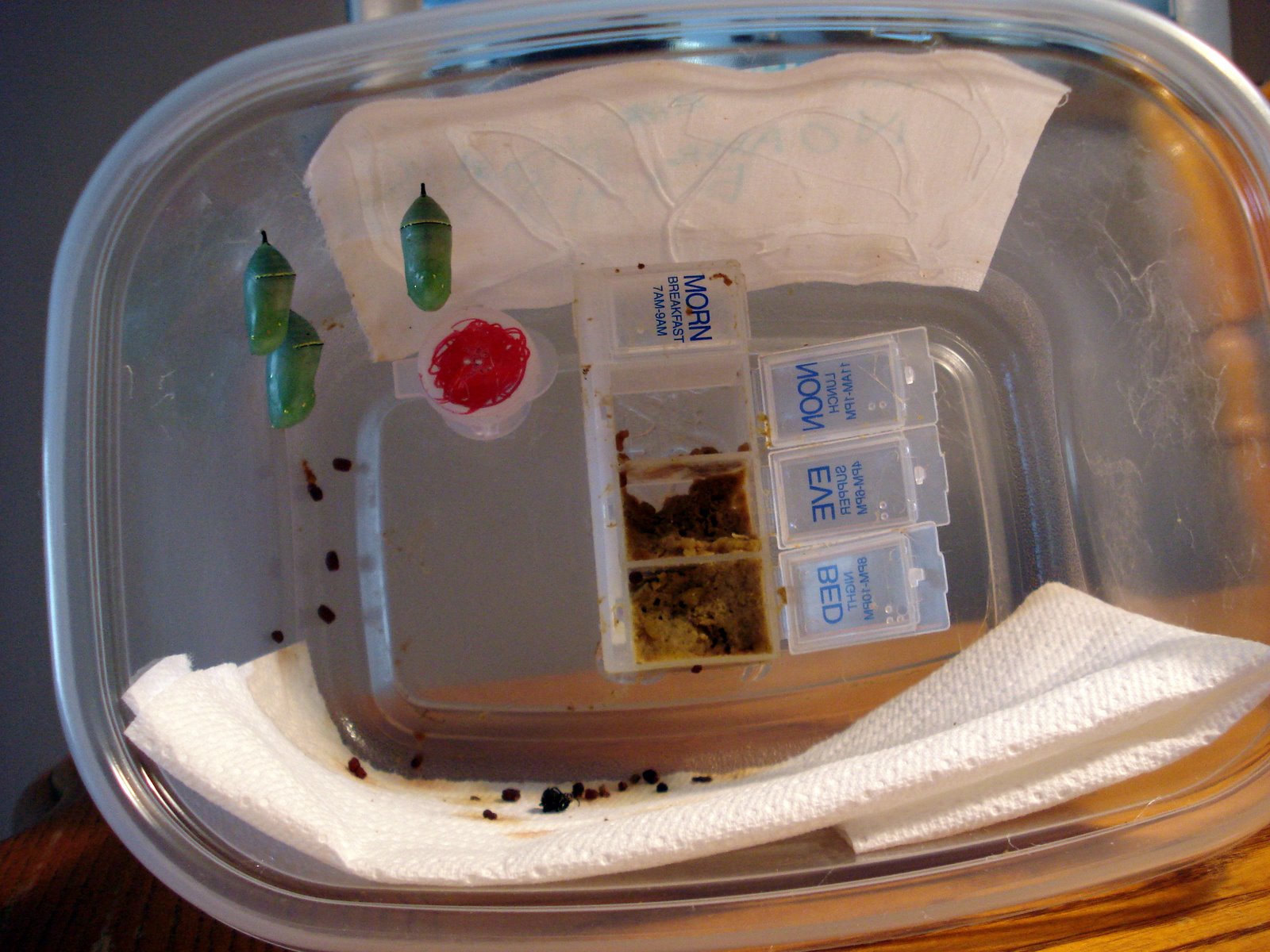
Kindergarten's chyrsalides are still mostly lime-green. With cooler temperatures in the classroom over the weekend, we may not see additional changes in our rearing boxes until Monday or Tuesday.
 News from the ISS: a female and male monarch have emerged (eclosed)! The butterflies were able to work their way out of the chrysalides and even though the chrysalides were floating, the butterflies were able to expand their wings. The third chrysalis can be seen floating in the foreground. It is no longer attached to its silk button; one of the other butterflies pulled it loose and it is now floating free in the rearing chamber.
Last night I cut large pieces of cardboard to the specifications of our budding engineers for the space shuttle. I figured out a way of attaching a few reusable plastic food containers and cardboard tubes that I had hoped would support the children's understanding of how we would create a three dimensional pretend play area based on the drawings they made previously.
We launched this engineering aspect of our Monarchs In Space project by opening painting stations in which children were invited to express their ideas on three panels of our space shuttle with gray, white, and black paint. Part two of this aspect of our engineering project will resume tomorrow when we get out the paint again and work on the panels for our functional "sliding door" that will connect the shuttle to the space station.
 We're waiting for wings in kindergarten! As time passes we continue making daily observations of the chrysalides, hanging silently from their silk buttons, in the rearing boxes on our project table.
Kindergartners are taking turns working in small groups to complete drawings of the chrysalides, drawing in pencil and layering color with marker. Children have an opportunity to look very closely through the plastic wrap window of the rearing boxes at the chrysalides dangling from the top.
Today we also used the computer projection screen to view the series of photos of the changes the caterpillars went through over Thanksgiving break. These were changes that the children missed seeing though we had observed them in September when we were working with caterpillars from our schoolyard.
Many details were visible in the photos that we projected larger than life on the screen. WE saw the beds of silk and silk button attachments to the cremasters of caterpillars hanging in J form, we saw caterpillars eating, resting, and searching for a place to put down beds of silk, we saw caterpillars making pink frass, caterpillars in J form turning green, piles of striped caterpillar skin that fall after a chrysalis is formed, chrysalides in various stages of formation, yellow to lime green color changes in the chyrsalides, gold edging and spots on "older" chrysalides, the segmented insect body in a "young" chrysalis, and most intriguing to the children, the appearance of thin white lines of butterfly wing under the green cuticle of the chrysalides.
 One of our caterpillars formed a chrysalis that fell to the bottom of the rearing box when the box was moved over Thanksgiving break. In the above photo you can see the chrysalis on the bottom under the feeding boxes. In space on board the ISS, two chrysalides became loose too.
We opened our box and used thread and a drop of hot glue to re-attach the chrysalis to the top of the rearing box. We were worried that maybe the butterfly couldn't come out if it was not hanging up like the others. Some kindergartners were thinking that if we could put it back up, we should; I showed them how we could try and replicate the caterpillar's attachment with materials that we had in our classroom. The following photo shows the repair.


 We see our caterpillars are in various stages of beginning the process of pupating. From the Monarchs in Space Teachers Guide we understand that a caterpillar will empty its gut when it has finished developing and at that time produces frass with a pinkish hue. Pinkish frass is visible in the rearing boxes today. After emptying its gut, a monarch caterpillar will search for a sheltered, horizontal surface; as we see the caterpillars are orienting to the underside of the top of the rearing boxes.
To attach securely for the duration of the pupal (chrysalis) stage, the caterpillar spins a bed of silk and then a silk button in the center. It is from this button, with its anal prolegs (these are the pair of suction cup legs at the end of the caterpillar) anchored by crochets (tiny hooks on the legs) that the caterpillar releases it's hold and hangs like a letter J, upside down. It may, depending on the temperature, hang in this position for 12-16 hours.
Toward the end of the J stage, the caterpillar's color changes due to the chrysalis developing inside and the caterpillar usually straightens in its hanging position. What happens next, happens quickly. Simply stated, the caterpillar succumbs to contractions that cause the caterpillar's skin to split and move upward toward the silk button attachment, revealing the chrysalis that has been forming. When the skin reaches the silk button, the caterpillar's cremaster is released and pushed into the silk button and the chrysalis twists to secure the cremaster to the silk.
Over the next few hours as this process repeats itself in our rearing boxes, we expect to see these beautiful, lime green jewels of metamorphosis hanging where our letter J stage caterpillars are hanging now.
 More news from the ISS: The third monarch on the ISS successfully emerged (eclosed)! More photos and video can be viewed on the Monarchs in Space website.